
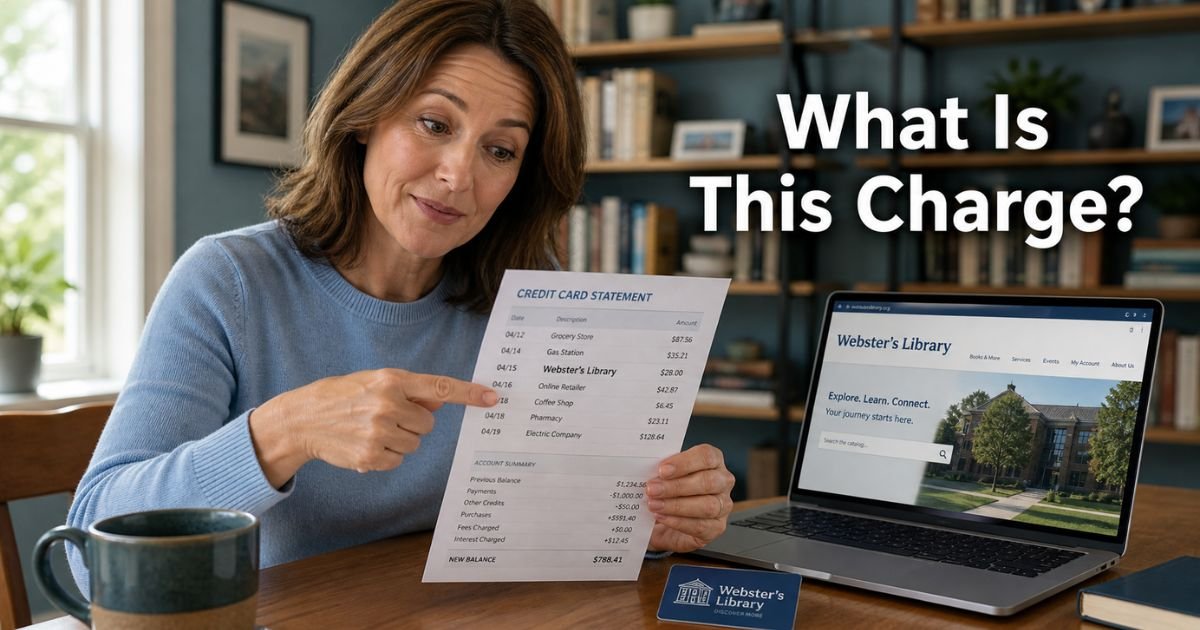
You open your credit card statement, scan the list of charges, and there it is: Webster’s Library. Your stomach drops for a second. Did someone in your family check out books? Is it a mistake? Or worse, fraud? You are not alone. Thousands of people every month spot this exact line on their statements and wonder the same thing.
The good news? In most cases, the Webster’s Library charge on credit card is completely legitimate. In this guide, you will learn exactly what triggers these charges, how to spot them on your statement, and what to do if you want them to stop.
Table of Contents
What Is a Webster’s Library Charge?
A Webster’s Library charge appears when someone pays for library services with a credit or debit card. Several libraries across the United States use the name “Webster” and accept online payments.
The most common sources include Webster University Library in Missouri and public libraries in places like Webster, New York, or Webster, Massachusetts.
These charges do not mean someone stole your card. They usually show up after you or a family member pays fines, replaces a lost book, or buys a non-resident library card.
The payment often routes through a third-party processor such as CashNet. That is why the descriptor on your statement may read “WEBULIBRARY,” “CASHNET WEBSTER,” or simply “Webster’s Library” instead of the full library name.
Common Reasons You See This Charge
Libraries charge for a handful of everyday services. Here are the usual culprits:
- Overdue or lost book replacement fees
- Processing fees for damaged materials
- Non-resident library card fees (often $25 per year)
- Printing or copying charges (black-and-white pages run about 20 cents; color can cost $1)
- Interlibrary loan fees for books from other libraries
Many modern libraries no longer charge daily overdue fines, but they still bill you for books that go missing or come back damaged. One quick online payment with your card and the charge lands on your statement a few days later.
Real Life Story
Take a 41-year-old teacher from suburban St. Louis. She let her daughter borrow a popular novel from Webster University Library through a family friend’s account.
The book never made it home. Two months later she spotted a $42.50 “Webster’s Library” charge on her credit card. At first she panicked and thought it was fraud.
A quick call to the library confirmed her daughter had checked out the book and never returned it. She paid the replacement cost plus a small processing fee.
Problem solved in under five minutes. She now sets phone reminders for due dates.
How to Confirm the Charge Belongs to You
First, check your statement carefully. Look at the exact date of the charge and the amount. Then ask yourself:
- Did anyone in your household visit a Webster library recently?
- Did you pay for printing, a library card, or a lost item online?
- Do you or a family member attend Webster University or live near a Webster Public Library?
Next, log into your library account if you have one. Most systems let you view recent transactions instantly. If you still feel unsure, pick up the phone. Call the library directly using the number on their official website. They can match the charge to your account in seconds.
Pro Tip: Keep a small notebook or note on your phone labeled “Library Payments.” Every time you pay a fine or fee online, jot down the date, amount, and library name. This simple habit takes 10 seconds and saves hours of confusion later.
Steps to Stop or Dispute the Webster’s Library Charge
If the charge is legitimate but you want no more surprises, follow these steps:
- Contact the library right away and ask them to remove any linked payment method from your account.
- Update your library profile to use a different card or switch to cash/check for future fees.
- If you have a non-resident card, consider letting it expire instead of renewing.
If the charge looks unauthorized:
- Call your credit card issuer immediately and dispute it as fraud.
- Change your card number to stop any future attempts.
- File a police report if you suspect identity theft.
Most banks give you 60 days from the statement date to dispute a charge. Act fast for the best results.
Common Mistake: Ignoring the charge because it is small. Scammers sometimes test cards with tiny library-style amounts first, then hit harder. Always verify every unfamiliar charge, even if it is only $5 or $10.
Understanding Library Payment Processors
Many libraries partner with CashNet or similar services to handle credit card payments securely. That is why the name on your statement rarely matches the library exactly.
Webster University, for example, directs users to commerce.cashnet.com/webulibrary. The system processes the payment and sends the money to the library within a day or two.
This setup protects your information, but it can create confusion when the charge shows up. Rest assured, reputable libraries never store your full card details themselves.
Bottom line: The Webster’s Library charge almost always ties back to a real library transaction processed through a secure payment portal.
How Different Webster Libraries Handle Fees
| Library Location | Common Fees | Typical Charge Amount | Payment Processor | Notes |
|---|---|---|---|---|
| Webster University (MO) | Lost book replacement + processing | $30–$120 | CashNet (webulibrary) | No daily overdue fines |
| Webster Public Library (NY) | Non-resident card, printing, lost items | $25 card / $0.20–$1 printing | Online portal | Free cards for local residents |
| Webster, MA Public Library | Copying, lost materials | Varies | Direct card payment | Check website for current rates |
| Other Webster branches | Replacement cards, events | $1–$25 | Varies | Many offer free cards to locals |
Source: Official library websites and payment policies as of 2026. Always verify current fees directly with the library.
What If It Is Not a Library Charge?
In rare cases the descriptor could point to websterslibrary.com, an online creative platform that offers AI-powered imagination tools and subscription plans.
If you recently signed up for story generation or image creation there, the charge would appear under the same name. Check your email for a welcome message or receipt from that site and cancel through your account dashboard if you no longer need it.
How to Prevent Future Mystery Charges
Set up transaction alerts on your credit card app. Most issuers let you receive a text or email the moment any charge posts. You can also review your statements weekly instead of monthly. These two habits catch surprises early and give you time to act.
FAQs: Webster’s Library Charge on Credit Card
Q. Why does my credit card show Webster’s Library when I never visited one?
A. You or someone with access to your card may have paid a library fine, printing fee, or lost-book charge online. Family members, roommates, or even college students often use shared cards without mentioning it. The payment processor name hides the exact library, so the charge looks mysterious at first glance. Call the number on your statement or check recent emails for clues.
Q. Can I get a refund for a Webster’s Library charge I did not authorize?
A. Yes, in most cases. Contact your credit card issuer within 60 days and dispute the transaction as unauthorized. Provide the date and amount. At the same time, reach out to the library to confirm whether an account exists in your name. If it is fraud, the bank usually reverses the charge quickly and issues you a new card.
Q. How do I stop recurring Webster’s Library charges on my statement?
A. Log into the library’s online portal or websterslibrary.com (if that is the source) and remove your card from the saved payment methods. If you have an active non-resident card or subscription, let it expire or cancel it directly. Set a calendar reminder so you stay ahead of any automatic renewals.
Conclusion
The Webster’s Library charge on credit card is usually just a routine library fee that got lost in the statement shuffle. By checking your library account, calling when needed, and setting up alerts, you stay in control.
Keep an eye on your statements every month. Small habits like that protect your money and give you real peace of mind. If you spotted another puzzling charge recently, explore our other guides right here on ExplainCharges.com.
Disclaimer: The content on ExplainCharges.com is for informational and educational purposes only and does not constitute financial, legal, or professional advice. We are not affiliated with any companies or services mentioned. The information provided may not apply to your specific situation. If you suspect unauthorized charges or fraud, contact your bank or credit card issuer immediately. Always verify details directly with the source and consult a qualified professional if needed.
Meet the Author
