
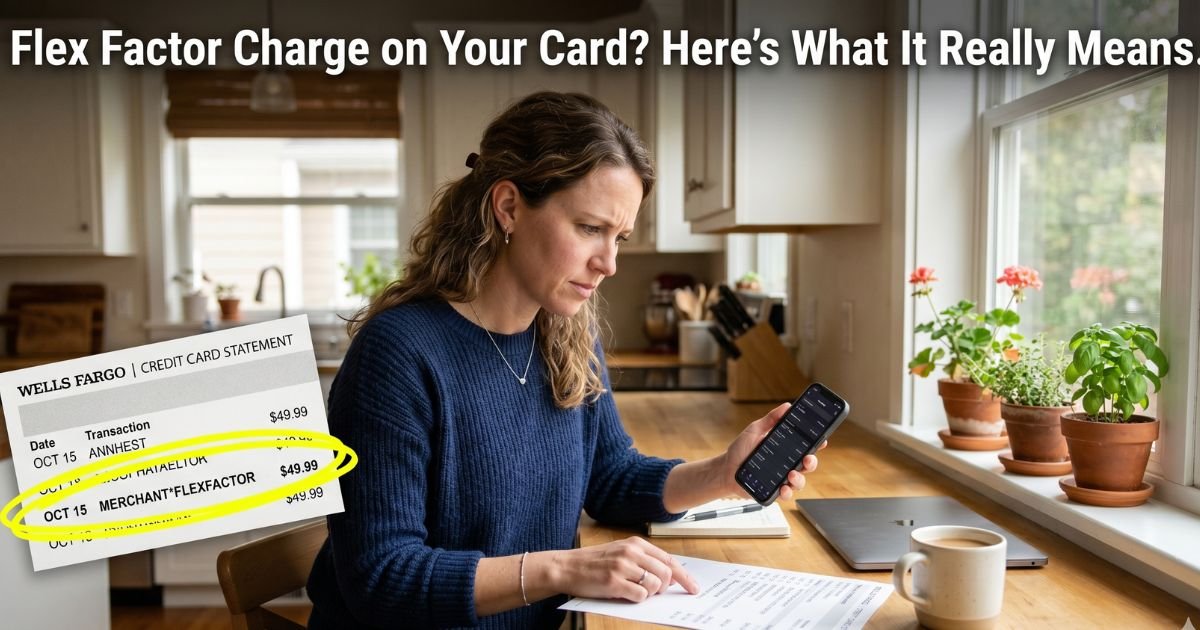
You check your credit card app during a quiet moment and freeze. There it is: “FLEXFACTOR,” “Flex Factor,” or something like “STORENAME*FLEXFACTOR” for $49.99 or another amount.
You rack your brain. You never signed up for any service called Flex Factor. You did not order anything recently. Yet the charge sits there, staring back at you.
You are not alone. Many people spot this exact line and wonder if their card was hacked or if they missed something. The good news is this charge is almost always legitimate, though confusing.
Here you will learn exactly what the Flex Factor charge on credit card means, why it shows up, and the straightforward steps to verify it, request a refund, or prevent future surprises.
Table of Contents
What Is the Flex Factor Charge on Credit Card?
FlexFactor is not a store or subscription service you shop from directly. It is a behind-the-scenes payment partner that helps online merchants recover declined card transactions in real time.
When your card gets declined at checkout (maybe for insufficient funds, a temporary hold, or a bank flag), FlexFactor steps in, checks the transaction, and completes the purchase if everything looks legitimate.
They charge your card for the exact original amount—no extra fees—and use a smart descriptor so the merchant name often appears on your statement too.
That is why you might see “FLEXFACTOR” alone or paired with the store name after an asterisk, like “SHOPNAME*FLEXFACTOR.”
How the Charge Usually Happens
You add items to your cart on an e-commerce site, enter your card details, and think the order went through or failed. If the original payment declined, FlexFactor rescues it seconds later. The charge posts a short time afterward, often when you have already moved on and forgotten the attempt.
Take Emily, a 35-year-old graphic designer from California. She tried to buy a pair of wireless headphones during a quick lunch break. The site showed an error, so she closed the tab.
A week later she noticed a Flex Factor charge for the exact amount. “I thought the order never processed,” Emily said. “Turns out FlexFactor finished it on behalf of the store.”
Her story matches what thousands of shoppers experience every month.
Bottom line: The Flex Factor charge on your credit card is simply a rescued payment for something you actually tried to buy from an online merchant.
Why Does This Charge Feel So Unexpected?
Declined payments happen more often than most of us realize. A momentary low balance, a bank fraud alert, or even a network glitch can trigger it.
FlexFactor’s job is to save the sale for the merchant without you having to re-enter your card. Their system uses AI to decide quickly and safely.
Because the descriptor focuses on “FlexFactor,” many people do not connect it to the original store right away. The charge is real and authorized (you gave your card details at checkout), but it can still catch you off guard.
How to Verify and Stop a Flex Factor Charge
First, look closely at the full descriptor on your statement. The merchant name usually appears before or after the asterisk. That is your clue. Contact that merchant directly to confirm the order, request a refund, or cancel any ongoing subscription.
If you cannot spot the merchant or need extra help, reach FlexFactor’s consumer support:
- Call +1 408-459-4427 (available during business hours).
- Email customersupport@flexfactor.io.
- Fill out the form at flexfactor.io/consumer-contact.
Be ready with the transaction date, amount, and descriptor. They will help you identify the merchant or forward your request.
Pro Tip
Snap a screenshot of the exact charge line before you call anyone. Include the full descriptor and date. This one habit speeds up every conversation and gives you clear proof if you need to dispute with your bank.
What to Do If You Want a Refund
If the purchase was something you no longer want or never intended, start with the merchant. Most have straightforward refund policies, especially for recent orders. Explain the situation politely and ask for a full refund.
If the merchant does not respond quickly, contact your credit card issuer. Under federal rules you can dispute the charge as long as you act within 60 days.
Many banks reverse these quickly once you explain it was a recovered payment you no longer want. FlexFactor itself does not add fees, so the refund should match the original amount.
Common Mistake
Assuming it is fraud and immediately canceling your card. In most cases this is a legitimate rescue of your own attempted purchase. Canceling the card creates extra hassle while the merchant or FlexFactor can usually resolve it faster with a simple refund.
How to Spot and Prevent Similar Payment Recovery Charges
Payment recovery services like FlexFactor are common now because online shopping has grown. Here is a simple checklist you can use every month:
- Scan new charges within a day or two of posting
- Turn on text or app alerts for any amount over $20
- Use virtual card numbers for one-time online buys
- Keep a quick note on your phone about recent checkout attempts
If a descriptor ever looks unfamiliar, search the exact wording plus “charge” online. You will usually find the merchant right away.
| Charge Descriptor Example | Typical Amount | What It Usually Means | First Step to Resolve |
|---|---|---|---|
| FLEXFACTOR | Varies | FlexFactor rescued a declined payment | Check full line for merchant name |
| SHOPNAME*FLEXFACTOR | Varies | Same service with store name shown | Contact the store directly |
| FF*MERCHANT | Varies | Shortened FlexFactor smart descriptor | Use FlexFactor support form or phone |
| GET-FLEX or FLEX-FACTOR | Varies | Similar recovery services | Call phone number listed on statement |
Table based on customer reports and FlexFactor documentation as of April 2026. Always verify details on your own statement.
When to Contact Your Bank or Credit Card Issuer
If the merchant does not reply within a few days or you believe the original purchase was unauthorized, call the number on the back of your card. Describe the charge and say you want it investigated. Your issuer can reverse it and may block future attempts from the same merchant or processor. This step also creates an official record for your protection.
FAQs: Flex Factor Charge on Credit Card
Q. Why did I get a Flex Factor charge on my credit card when I never ordered anything?
A. The Flex Factor charge usually appears when you tried to buy something online and the original payment declined. FlexFactor, a payment recovery service, stepped in to complete the transaction for the merchant. Look for the store name in the full descriptor. It is almost always tied to a real checkout attempt you made, even if the site showed an error at the time.
Q. How do I cancel or refund a Flex Factor charge on my statement?
Start by identifying the merchant name after the asterisk in the descriptor. Contact that store directly and request a refund or cancellation. If you need help, call FlexFactor at +1 408-459-4427 or email customersupport@flexfactor.io. They do not run the subscription themselves but will connect you to the right merchant. Your bank can also dispute the charge if the merchant does not respond.
Q. Is the Flex Factor charge a scam or just a regular payment?
A. It is a legitimate service used by many online stores to rescue declined payments. FlexFactor does not sell products or run subscriptions itself. They simply process the exact amount you originally agreed to pay. No extra fees are added to you. If you do not want the item, contact the merchant or your bank for a refund—most cases resolve quickly and smoothly.
Conclusion
The Flex Factor charge on credit card is almost always a rescued payment from an online store you shopped with. FlexFactor simply finishes what your card started when it declined at checkout. Once you spot the merchant name in the descriptor, you can reach out, request a refund, or cancel any future billing with confidence.
Take a quick look at your recent transactions right now and set up alerts so surprises stay rare. A few simple habits keep your money where it belongs. You are in control, and understanding one charge today saves you time and stress down the road.
If this cleared things up for you, explore our other guides on common mystery charges here at ExplainCharges.com. Your statements can stay clean with just a little awareness.
Disclaimer: The content on ExplainCharges.com is for informational and educational purposes only and does not constitute financial, legal, or professional advice. We are not affiliated with any companies or services mentioned. The information provided may not apply to your specific situation. If you suspect unauthorized charges or fraud, contact your bank or credit card issuer immediately. Always verify details directly with the source and consult a qualified professional if needed.
Meet the Author
