
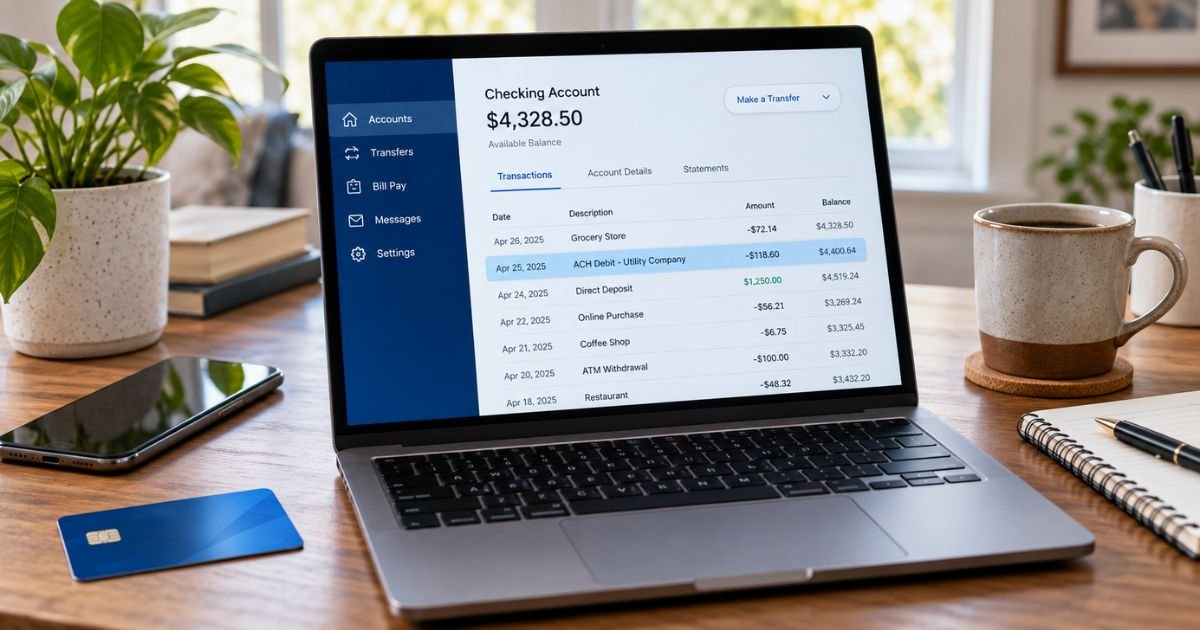
Seeing an unfamiliar ACH charge on your bank statement can feel confusing, especially if you don’t remember authorizing a payment. Fortunately, many ACH transactions are legitimate payments for everyday bills, subscriptions, or transfers.
Understanding what ACH means can help you identify the transaction. Here’s how to recognize ACH payments, investigate unknown withdrawals, and protect your bank account.
Table of Contents
What Is an ACH Charge on Bank Statement?
An ACH charge on your bank statement typically means money was transferred electronically through the Automated Clearing House (ACH) network. This US payment system allows banks, businesses, and individuals to move money between bank accounts.
ACH payments commonly cover utility bills, mortgage payments, loan installments, and subscriptions. Employers also use ACH to deposit salaries directly into employees’ accounts.
The ACH network handles two main transaction types:
- ACH Debit: Money is withdrawn from your account to pay a business, organization, or another party.
- ACH Credit: Money is deposited into your account, usually through payroll, refunds, or transfers.
An ACH charge isn’t automatically a bank fee or fraudulent transaction. The description identifies the payment method, not necessarily the company receiving your money.
How Does an ACH Charge Appear on Your Bank Statement?
ACH transactions can appear under different descriptions depending on your bank and the organization processing the payment.
Here are common examples:
| Bank Statement Description | Typical Meaning |
|---|---|
| ACH DEBIT | Electronic withdrawal from your account |
| ACH CREDIT | Electronic deposit into your account |
| ACH PPD | Prearranged payment or deposit |
| ACH WEB | Internet-authorized ACH debit |
| ACH TEL | Telephone-authorized ACH debit |
| ACH CCD | Corporate credit or debit transaction |
| ACH RETURN | Returned ACH transaction |
| ACH PAYMENT | Electronic payment between accounts |
Your statement may also show a merchant name, payment reference, or company identification number.
For example, an entry reading “ACH DEBIT ELECTRIC BILL” may represent an authorized utility payment.
However, abbreviated descriptions can make legitimate transactions difficult to recognize.
Why Is There an ACH Charge on Your Bank Account?
Several everyday activities can generate ACH withdrawals. You may have authorized one without realizing the payment would appear under an unfamiliar description.
Common reasons include:
1. Automatic bill payments
Your electricity, water, internet, or insurance provider may withdraw monthly payments directly from your checking account.
2. Loan and mortgage payments
Banks and lenders commonly collect scheduled payments through ACH. These withdrawals generally occur on agreed payment dates.
3. Subscription renewals
Some gyms, membership programs, and online services accept direct bank payments. Your subscription may renew automatically.
4. Credit card payments
When you pay a credit card bill using your checking account, the payment may appear as an ACH debit.
5. Transfers between bank accounts
Moving money between accounts at different financial institutions may create an ACH transaction.
6. Unauthorized withdrawals
Someone may have obtained your account information and initiated an unauthorized payment. This possibility deserves immediate investigation.
How to Identify an Unknown ACH Charge
An unfamiliar ACH description doesn’t necessarily indicate fraud. However, you should verify the payment before assuming it’s legitimate.
Follow these steps:
1. Review the transaction details. Check the amount, posting date, merchant description, and transaction reference.
2. Check previous statements. Look for matching payments from earlier months that might indicate recurring billing.
3. Review your payment arrangements. Examine subscriptions, utility accounts, loans, and automatic payment agreements.
4. Search your email. Look for invoices, payment confirmations, or renewal notices matching the amount.
5. Ask other account holders. Someone sharing your account may have authorized the withdrawal.
6. Contact your bank. Request the ACH originator’s name, company identification information, and transaction trace number, if available.
Your bank may have more information than appears on your statement. However, the available details vary by institution.
Pro Tip: Save a screenshot of an unfamiliar ACH transaction before contacting your bank. Keep its date, amount, and reference information for easier follow-up.
Is an ACH Charge Legitimate or a Scam?
ACH is a legitimate US banking payment system. However, scammers can sometimes misuse bank account information to request unauthorized withdrawals.
Watch for these warning signs:
- You don’t recognize the payment recipient.
- Several unexplained withdrawals appear.
- The same company charges you after cancellation.
- The withdrawal exceeds your authorized amount.
- You notice payments connected to services you never requested.
None of these signs proves fraud on its own.
Consumer reports on Reddit describe situations where abbreviated ACH descriptions made identifying payment recipients difficult. These experiences don’t establish that every unidentified ACH transaction is fraudulent.
Likewise, BBB or Trustpilot reviews cannot verify a generic ACH entry because ACH isn’t a specific merchant. You need the actual company’s identity before evaluating its reputation.
How to Dispute an Unauthorized ACH Charge
If you believe an ACH withdrawal was unauthorized, contact your bank or credit union immediately.
For qualifying consumer electronic fund transfers, federal Regulation E provides important dispute protections.
Here’s what to do:
- Report the transaction through your bank’s official customer service or fraud department.
- Explain that you didn’t authorize the ACH withdrawal.
- Provide the transaction date, amount, and statement description.
- Ask how to submit a formal error notice or unauthorized transaction claim.
- Keep copies of your communications and any case number.
Generally, you should report an error within 60 days after your bank sends the statement showing it. Waiting can affect your rights and potential liability.
Your bank generally has 10 business days to investigate. Certain circumstances allow a longer investigation, sometimes with provisional credit.
A refund isn’t automatic merely because you dispute a payment. Your bank must assess the claim under applicable requirements.
How to Stop Future ACH Charges
If an ACH withdrawal comes from a subscription or recurring payment you no longer want, you can generally revoke your payment authorization.
Start with the company receiving your money. Request cancellation of the automatic withdrawals and keep written confirmation.
Next, notify your bank that you’ve revoked the company’s authorization.
You can also request a stop-payment order for a scheduled preauthorized electronic withdrawal. Under federal rules, you generally must notify your bank at least three business days before the scheduled payment.
Your bank may charge a stop-payment fee. Ask whether written confirmation is required.
Common Mistakes: Stopping an ACH payment doesn’t automatically cancel your subscription, loan, or other contract. You may still owe legitimate amounts under your agreement.
ACH Charge vs. Debit Card Charge vs. Wire Transfer
These payment methods all move money, but they work differently.
| Feature | ACH Payment | Debit Card Payment | Wire Transfer |
|---|---|---|---|
| Payment method | Bank-to-bank network | Card network | Bank transfer network |
| Typical use | Bills and deposits | Shopping | Large or urgent transfers |
| Processing | Same day or several business days | Often authorized quickly | Often same day domestically |
| Recurring payments | Common | Common | Less common |
| Reversals | Rules-based | Dispute procedures | Often difficult |
ACH payments generally cost less to process than wire transfers, although bank fees vary.
Importantly, ACH withdrawals don’t require someone to physically use your debit card.
How to Protect Your Bank Account From Unauthorized ACH Withdrawals
A few precautions can reduce the risk of unexpected withdrawals.
- Enable transaction alerts through your banking app.
- Review bank statements regularly.
- Avoid sharing your routing and account numbers unnecessarily.
- Cancel unused subscriptions.
- Keep records of ACH authorizations.
- Use strong passwords and multifactor authentication.
- Report suspicious withdrawals promptly.
If repeated unauthorized payments occur, ask your bank about ACH debit blocks or account replacement.
Some banks offer additional ACH controls, although availability may depend on your account type.
FAQs: ACH Charge on Bank Statement
Q. Why did I receive an ACH charge without authorization?
A. An unfamiliar ACH withdrawal may come from a forgotten automatic payment, an incorrect transaction, or unauthorized account activity.
Check your payment history first. If you cannot identify the withdrawal, report it to your bank promptly.
Q. Can I get my money back from an ACH charge?
A. You may qualify for reimbursement if your bank determines that the withdrawal was unauthorized or otherwise covered by applicable error-resolution rules.
Refund eligibility depends on the circumstances and reporting deadlines. Contact your bank to begin the dispute process.
Q. Does an ACH charge mean someone has my bank account number?
A. Not necessarily. Many legitimate companies use bank account details you previously provided to process authorized ACH payments.
However, an unknown withdrawal could indicate unauthorized use of your banking information. Your bank can help investigate.
Q. Can an ACH charge happen without using my debit card?
A. Yes. ACH transactions generally use bank account and routing information instead of debit card numbers.
That’s why an ACH withdrawal can appear even when you haven’t used your debit card recently.
Conclusion
An ACH charge on your bank statement usually represents an electronic payment, automatic withdrawal, or bank transfer. Many transactions are legitimate, but an unfamiliar description deserves attention.
Check your payment history, identify the originating company, and contact your bank if the charge remains unexplained.
If you believe a withdrawal is unauthorized, report it quickly. Regular account monitoring can help you identify unexpected payments before they become recurring problems.
Disclaimer: This article is for informational purposes only and does not provide financial or legal advice. Banking policies and dispute procedures may vary by issuer or financial institution. Verify account-specific questions, transaction details, and refund eligibility directly with your bank or the company involved.
Meet the Author
