
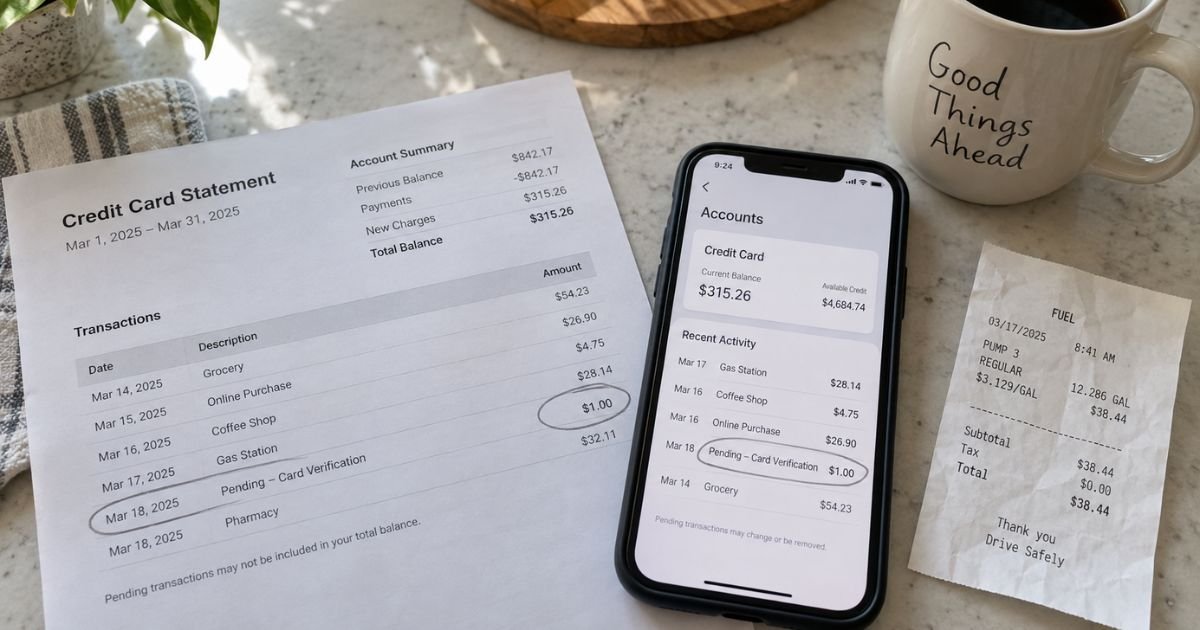
A $1 charge on a credit card can feel confusing if you don’t recall buying anything that small. Many of these lines are temporary checks, not finished sales.
Your issuer is often just confirming the card works before a real purchase, a subscription, or a pump starts.
This guide explains the usual reasons for a $1 charge on a credit card, how long a hold typically lasts, and when you should treat it as a problem.
Table of Contents
What Is a $1 Charge on a Credit Card?
A $1 charge on credit card is typically an authorization, not a payment that has settled. The merchant asks your issuer, “Is this card real, open, and able to take a charge?” Your issuer then reserves $1 of available credit. That reservation often shows as PENDING, PRE-AUTH, or AUTH.
No money has to move to the merchant at that stage. Official commentary to the CFPB’s Regulation Z even describes a pay-at-the-pump example where the station first requests a $1 authorization hold, then later submits the real fuel amount. The $1 is a test. The later amount is the sale.
Streaming and device companies describe the same handshake. Official Roku help says an authorization hold is commonly $1 and is used to confirm the account is valid for a later channel or movie charge.
Official Starz help calls a $1 line a pre-authorization hold that appears as pending when you start a plan or change cards. Official Google Pay help says a verification charge can be a small temporary Google line under $1.95 so you can read a code from the last digits.
So a $1 charge on a credit card is often a card check. It can also be a real one-dollar sale, a $0.99 trial that rounds on the statement, or, less often, someone testing a stolen number. The pending-versus-posted status and the merchant name tell you which path you are on.
Pending $1 versus posted $1
| Status | What it usually means | Typical next step |
|---|---|---|
| Pending, PRE-AUTH, or AUTH for $1.00 | Temporary hold to test the card or start a sale | Wait for it to drop or change to the real amount |
| Posted $1.00 that later shows a matching credit | Token charge that the merchant reversed | Confirm the credit posts |
| Posted $1.00 with no credit and a known merchant | Real small purchase, trial, or fee | Match it in that account |
| Posted $1.00 from a name you never used, then larger charges | Possible card testing | Call the issuer the same day |
A pending $1 generally reduces available credit by a dollar. It typically does not add to the balance you owe until it posts. Interest usually does not accrue on a hold. Timing still varies by issuer.
Official Roku help says that kind of hold is typically released in 3 to 5 business days, and to call the bank if it lasts more than 30 days.
Other merchant pages say a few days to about a week. Hotels and rentals can hold longer than a pump or a streaming check. Your issuer, not the merchant blog, controls the drop date.
Common legitimate reasons
Think about what you did in the last few days.
- You paid at the pump. The station may authorize $1 first, then replace it with the gallons you pumped. Some pumps use a larger hold instead.
- You added a card to Netflix, a ride app, Apple, Google Wallet, Roku, or a store account.
- You started a free trial that requires a valid card.
- You changed the card on an existing subscription.
- A hotel, rental counter, or restaurant ran a small test before a larger hold.
- A processor such as Stripe sent a $0 or $1 authorization because your bank requires one to validate the card.
You may see more than one $1 line. Official Starz help notes multiple $1 holds can appear if you tried to create an account more than once. Each attempt can ping the card. Those extras should still fall off.
Pro Tip: Match the merchant name, not just the dollar. A $1 GOOGLE *TEMPORARY HOLD or APPLE.COM/BILL next to a new device login is usually a check. A $1 from a site you never visited is a different story. Open that merchant’s account or your email for a “card verified” note.
When a $1 charge actually posts
Some $1 lines are real sales.
A service may bill $0.99 or $1.00 as an intro price, then raise the amount at renewal. A merchant may capture a $1 verification instead of voiding it, then refund it days later. A charity, parking kiosk, or digital tip jar may genuinely charge a dollar.
If the posted $1 matches a receipt, treat it as a purchase. Cancel any trial or plan you do not want on that merchant’s site. Deleting the app generally does not stop billing.
If the $1 posts and you never signed up, look at the next few days of activity. Card testers sometimes send a tiny charge first. If it clears, they may try larger amounts. That pattern is a reason to call the issuer quickly. It is not a reason to assume every $1 is theft.
What you can and cannot cancel while it is pending
Your issuer generally cannot force a live merchant hold to disappear on demand. The merchant has to void the authorization or let it expire.
Call the merchant if you know who ran the $1 and you want it released sooner. Ask them to void the authorization, not refund a sale that never posted. Keep the date, time, and merchant name.
Do not try to “pay off” a pending $1 as if it were a bill. Paying your statement does not cancel a hold. The hold drops when the authorization ends or the real sale replaces it.
If the $1 has already posted and you do not recognize it, the merchant refund path and the issuer dispute path both matter. Start with the merchant when the name is a store you use. Start with the issuer when the name is unknown or other strange charges appear.
When to treat a $1 charge as a problem
Stay calm, then act if any of these fit.
- The $1 posted and never reversed after a week or two
- You did not add a card, buy gas, start a trial, or visit that merchant
- More $1 lines keep arriving from new names
- Larger charges follow the $1 from the same descriptor
- The merchant name looks misspelled or uses a random website
Call the number on the back of your card. Ask whether the $1 is still an authorization or a posted sale. Ask the issuer to add merchant details if the line is thin. If you believe the use was unauthorized, say that clearly.
For a U.S. credit card, unauthorized use and billing errors generally fall under the Fair Credit Billing Act. Written notice is typically due within 60 days of the statement that first showed the error.
Issuers generally must acknowledge a proper written notice within 30 days and finish within two billing cycles, not more than 90 days. Unauthorized use is generally capped at $50 under federal law.
Many large issuers advertise $0 liability when only the number was used. Confirm your card’s rule in writing.
Debit cards follow Regulation E instead. Report a problem fast. A posted $1 debit still reduces available cash until it is reversed or provisionally credited.
Pay any amount you do recognize by the due date. Ask whether the issuer can replace the card number if testers may have it.
Common Mistakes: Disputing a pending pump or hotel $1 the same hour you swipe. Ignoring a posted $1 from a site you never used. And waiting for “one more small charge” before you call. Pending checks can wait a few days. Posted mystery dollars should not.
Turn on transaction alerts for every amount, including $1. A text on a tiny pending line is often the first sign you added a card or that someone else did.
FAQs: $1 Charge on Credit Card
Q. Does a $1 charge on a credit card mean my card was stolen?
A. Not by itself. Many $1 lines are pending authorizations to confirm the card works at a pump, hotel, app, or subscription signup. Official company help pages for services such as Roku and Starz describe that $1 check. Call your issuer if the $1 posted, the merchant is unknown, or larger charges follow.
Q. How long does a $1 authorization stay on my account?
A. It varies by issuer and merchant. Official Roku help cites a typical release in 3 to 5 business days and says to contact the bank if a hold lasts more than 30 days. Other processors say a few days to about a week. Hotels and rentals can run longer than a streaming card check.
Q. Can I stop a pending $1 charge myself?
A. Usually not through the issuer app alone. The merchant has to void the authorization or let it expire. If you know the business, ask it to release the hold. If you do not know the business and the $1 has posted, use the issuer dispute path and consider a new card number.
Q. Why do I see several $1 charges from the same week?
A. Each signup attempt, card update, or declined retry can send another authorization. Official Starz help notes multiple $1 holds when someone tries to create more than one account. Several unknown merchants in a row is different. That pattern is worth an issuer call the same day.
Conclusion
A $1 charge on a credit card is most often a short authorization used to test the card or start a sale whose final amount is not ready yet. Official CFPB pump commentary and company help pages describe that $1 handshake.
Watch whether the line stays pending or posts, match the merchant name, and call your issuer when a posted dollar has no signup, receipt, or later credit behind it.
Disclaimer: This article is for general information only. It is not financial, legal, or tax advice. Hold times, descriptors, and dispute rules vary by merchant and issuer. Verify account-specific questions with the business on the line or with your card issuer.
Meet the Author
