
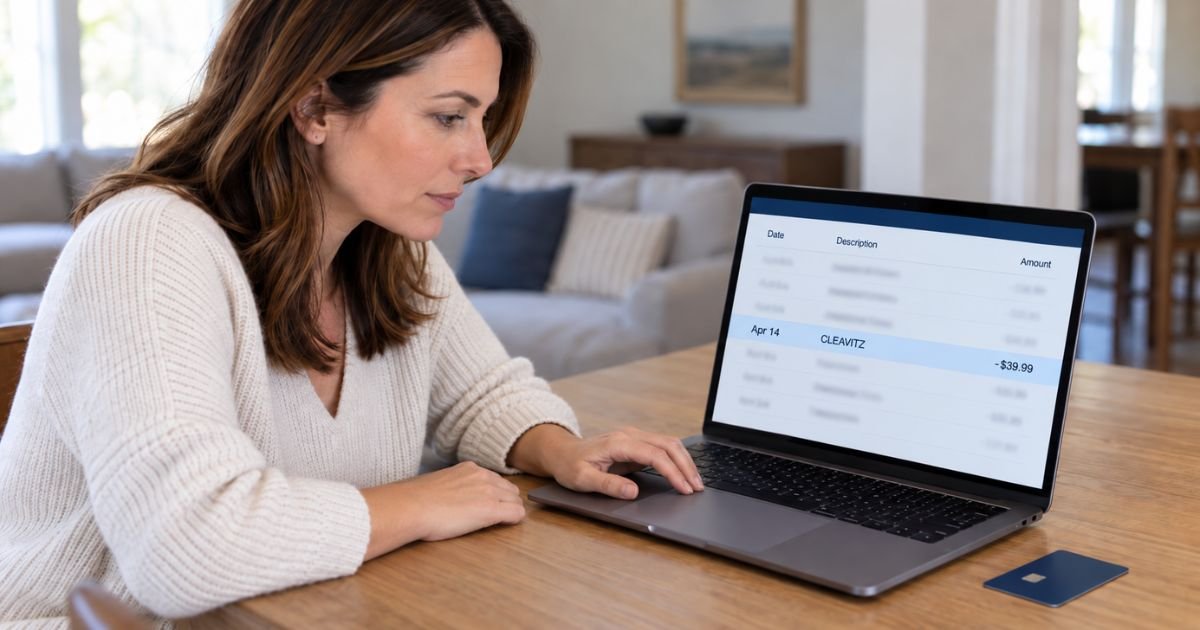
A Cleavitz charge on debit card can feel confusing if you don’t recall buying anything from a business with that name. An unfamiliar merchant descriptor is often legitimate, but you should verify it before assuming the transaction is yours.
Cleavitz appears to have been a real U.S. fashion brand, but current public billing information is limited. Here’s what is verified, what remains uncertain, and how you can handle a recent Cleavitz transaction.
Table of Contents
What Is a Cleavitz Charge on Debit Card?
A Cleavitz charge on debit card may refer to a purchase connected with Cleavitz, a women’s apparel brand that sold short layering tops designed to provide coverage under low-cut clothing.
Older public records clearly establish that Cleavitz was a real business. A 2011 press release identified Cleavitz as a Gaithersburg, Maryland company and described its product as a women’s half-top sold through Cleavitz.com.
Cleavitz continued promoting clothing products through at least 2015. Press materials from that period identified Julie Crotty as the company’s founder and CEO.
However, a recent Cleavitz debit card transaction is harder to explain with certainty. I could not verify a currently active official Cleavitz online store or a current official customer-support page.
| Statement clue | What it may indicate |
|---|---|
| CLEAVITZ | Possible Cleavitz merchant transaction |
| CLEAVITZ plus MD | May fit the historic Maryland business |
| POS CLEAVITZ | Debit card purchase at a merchant |
| CHECKCARD CLEAVITZ | Debit card transaction |
| PENDING CLEAVITZ | Temporary authorization still processing |
| Repeated Cleavitz charges | Requires further investigation |
The exact description may vary by your bank. Your issuer may also have more merchant information than it shows on the regular statement.
Was Cleavitz a Real Company?
Yes. Historical evidence shows Cleavitz was an actual apparel brand rather than a name created only for bank statement charges.
Cleavitz marketed a short top worn over a regular bra and underneath other clothing. The company promoted the product at fashion trade shows and through online retail.
There is also patent evidence tied to the product design. U.S. Patent 8,550,872 describes a bra top intended to provide coverage under low-cut clothing and lists Julie Upton and Brian Crotty as inventors.
A 2014 Cleavitz announcement also publicly linked that patent to the company’s clothing design.
This history confirms that the Cleavitz name had a legitimate commercial use. It does not prove that a new Cleavitz transaction on your account comes from that historical company.
Why Might Cleavitz Appear on Your Debit Card?
The simplest possibility is a clothing or online retail purchase associated with the Cleavitz merchant name.
You may also see an unfamiliar name when a merchant’s legal business name differs from the website, store, or product name you remember. Banks can shorten or format transaction information differently.
Possible explanations include:
- A past or recent clothing purchase
- A purchase made by another authorized cardholder
- An online transaction processed under an older merchant name
- A merchant using a legacy business descriptor
- A pending authorization that later changes
- An unauthorized debit card transaction
Because current Cleavitz billing information is difficult to verify, avoid relying on assumptions based only on the merchant name.
Pro Tip: Search your email for “Cleavitz” and the exact dollar amount shown on your bank statement. Also check shopping receipts, digital wallets, and orders placed around the transaction date.
How to Identify the Cleavitz Transaction
Open the transaction details in your bank’s mobile app or website first. The detailed view may contain information that does not appear on the monthly statement.
Look for:
- A merchant city or state
- A telephone number
- A website
- The transaction type
- A merchant category
- Whether the payment was online
- Whether the transaction is pending
- A reference or authorization number
If the location says Maryland, that may be consistent with historical Cleavitz operations. Older company announcements placed Cleavitz in Gaithersburg, Maryland.
However, a matching state is only a clue. It should not be treated as confirmation by itself.
Ask anyone else authorized to use your debit card or joint account whether they recognize the purchase. A family member may remember the store even if they do not recognize the statement descriptor.
Should You Call a Cleavitz Phone Number Found Online?
Use caution.
Older press releases contain telephone numbers associated with Cleavitz, but those records are many years old. There is no reliable reason to assume those numbers still belong to the same business.
Do not send your debit card number, PIN, bank password, Social Security number, or one-time security code to a phone number found on an old webpage.
Instead, ask your bank for the merchant contact details attached to the actual transaction. Information provided directly through your issuer is more useful for identifying the specific charge.
Common Mistakes: Don’t call an unverified phone number simply because a search result connects it with Cleavitz. Old businesses can close, phone numbers can be reassigned, and third-party charge websites may repeat outdated details.
Is the Cleavitz Charge a Scam?
There is not enough reliable evidence to label every Cleavitz transaction fraudulent.
The Cleavitz brand itself has a documented history. However, there is limited current public evidence about its operating status, billing descriptors, refund policies, or customer service.
Searches of BBB and Trustpilot did not produce a clear current Cleavitz business profile with enough verified consumer data to establish a complaint pattern. Reddit evidence under this exact merchant name also appears limited.
That lack of complaints does not prove a transaction is legitimate. It simply means the public evidence is too thin to make a strong conclusion either way.
If you recognize the amount and purchase, the transaction may be legitimate. If neither you nor another card user recognizes it, treat it as potentially unauthorized until your bank identifies the merchant.
What to Do If the Charge Is Pending
A pending charge has not fully settled yet.
Merchant descriptions can sometimes change when a transaction moves from pending to posted. You may therefore get a clearer merchant name after the transaction settles.
Still, you do not have to ignore a clearly suspicious transaction. If you believe someone obtained your debit card information, contact your bank promptly and ask whether you should lock or replace the card.
Your bank can tell you whether the pending transaction can be disputed immediately or whether you need to wait until it posts.
What to Do If You Never Authorized Cleavitz
Contact your bank or credit union promptly if you cannot connect the transaction with anything you purchased.
The Consumer Financial Protection Bureau advises consumers to report unauthorized debit transactions quickly. If an unauthorized transaction appears on your statement while you still have your physical debit card, federal protections generally require you to notify your financial institution within 60 days after the statement containing the transaction was sent.
Your bank may ask:
- When you noticed the transaction
- Whether you still have the card
- Whether anyone else can use it
- Whether you recognize the merchant
- Whether similar charges appear
- Whether you previously gave the merchant permission
Your bank may investigate the transaction and may recommend replacing the debit card.
The CFPB also advises consumers to monitor their accounts closely after suspicious activity. Small unauthorized charges can sometimes be followed by additional transactions.
Can You Get the Money Back?
You may be able to recover an unauthorized debit card transaction, but the outcome depends on the circumstances and how quickly you report it.
The CFPB says banks generally have 10 business days to investigate many unauthorized electronic-transfer reports. Different timelines and temporary-credit rules can apply in some situations.
Do not assume a refund is automatic. Follow your bank’s dispute instructions and provide accurate details about the transaction.
Keep screenshots of the charge and any correspondence. Also record the date you reported the transaction and any case or dispute number your bank provides.
How to Protect Your Debit Card After an Unknown Charge
Check your recent transaction history for other unfamiliar merchants.
If your banking app lets you temporarily lock your debit card, that can help prevent additional purchases while you contact the bank. Follow your issuer’s instructions about whether a replacement card is necessary.
You may also want to change your PIN if you believe it was compromised. Do not reuse banking passwords on shopping websites.
Turn on transaction alerts if your bank offers them. Alerts can help you notice future debit card activity quickly.
FAQs: Cleavitz Charge On Debit Card
Q. What is Cleavitz on my debit card?
A. Cleavitz may refer to a historical women’s clothing brand based in Maryland. Current official merchant and billing information is limited, so you should match the charge with your own purchase records before treating it as legitimate.
Q. Is Cleavitz still an active company?
A. Cleavitz was clearly active in public records from at least 2010 through 2015. However, I could not verify a currently accessible official Cleavitz store or active customer-service page, so its present operating status is unclear.
Q. Is a Cleavitz debit card charge fraud?
A. Not necessarily. Cleavitz was a real brand, but an unfamiliar recent transaction should still be investigated because the merchant’s current billing activity cannot be confirmed from reliable public information.
Q. How do I dispute a Cleavitz charge?
A. Contact your bank or credit union and report that you do not recognize the debit card transaction. Ask for the full merchant details and follow the issuer’s process for disputing an unauthorized electronic transfer.
Conclusion
A Cleavitz charge on debit card may relate to the historical Cleavitz clothing brand, but current billing information for the merchant is limited. Older records confirm that Cleavitz was a legitimate Maryland apparel business, yet they do not verify the source of a new debit transaction.
Check the amount, date, merchant location, authorized card users, and purchase history first. If you still cannot identify the Cleavitz charge, contact your bank promptly and ask it to investigate the transaction.
Disclaimer: This article is for informational purposes only and is not financial or legal advice. Debit card protections, investigation procedures, and dispute policies may vary by bank and account. Verify account-specific questions with your financial institution.
Meet the Author
