
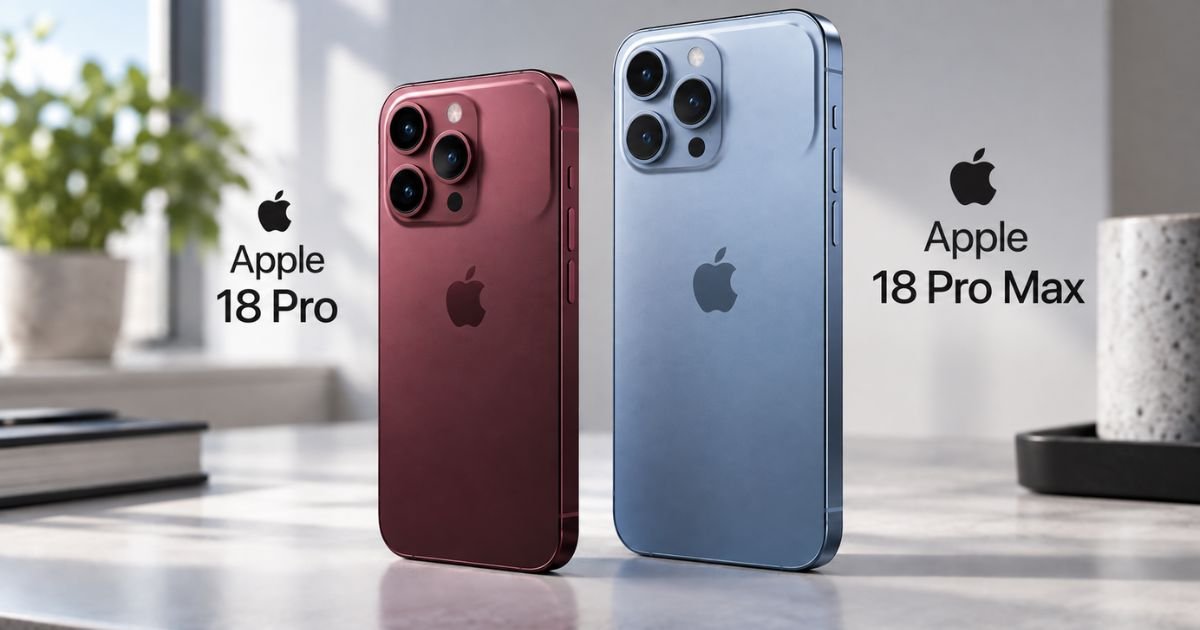
Apple launched the iPhone 18 Pro and iPhone 18 Pro Max on September 9, 2026, at its “Surprise and Shine” event. Pre-orders start Saturday, September 12, at 5 a.m. Pacific Time. The phones go on sale Friday, September 18.
The two models keep last year’s sizes and overall look. The bigger changes sit inside: a variable-aperture 48MP main camera, the 2-nanometer A20 Pro chip, a larger vapor chamber, and longer battery life.
U.S. starting prices are $1,199 for the 6.3-inch Pro and $1,299 for the 6.9-inch Pro Max, both with 256GB. That is $100 more than the iPhone 17 Pro models.
This guide covers what changed, what it costs, when you can buy one, and who should upgrade.
Table of Contents
iPhone 18 Pro and iPhone 18 Pro Max Launched
What Apple Announced
Apple did not introduce a standard iPhone 18 this fall. The company focused on the Pro pair and a separate foldable model called iPhone Duo. The regular iPhone 18 is expected later, in early 2027.
The iPhone 18 Pro uses a 6.3-inch Super Retina XDR OLED display. The iPhone 18 Pro Max uses a 6.9-inch panel of the same type.
Both keep 120Hz ProMotion, an always-on display, Ceramic Shield 2, and up to 3,000 nits peak brightness. The Dynamic Island is smaller and can show three Live Activities at once.
Colors are black, silver, glacier (a light blue), and a new burgundy finish. The aluminum frame and Ceramic Shield back glass are more closely color-matched than last year.
Storage options are 256GB, 512GB, 1TB, and 2TB. 2TB is new for iPhone.
iPhone 18 Pro Price and Availability
In the United States, prices start at:
- iPhone 18 Pro: $1,199 (256GB)
- iPhone 18 Pro Max: $1,299 (256GB)
Apple also lists monthly options of about $49.95 and $54.12 for 24 months. Higher storage costs more. Exact step-ups depend on the configuration you pick at checkout.
Key dates:
- Pre-orders: Saturday, September 12, 5 a.m. PT / 8 a.m. ET
- iOS 27: Monday, September 14
- In-store and delivery start: Friday, September 18
The first wave covers more than 65 countries and regions, including the U.S., Canada, the U.K., India, Japan, China, Australia, and much of Europe. A second group of about 20 countries follows on September 25.
U.S. models are eSIM-only. Those units get a slightly larger battery than dual-SIM versions sold in some other markets.
Carrier deals, trade-in credits, and Apple Upgrade financing can lower the out-of-pocket cost. Check Apple and your carrier the morning pre-orders open, because promotions often change that day.
The New Variable-Aperture Camera
The headline hardware change is the 48MP Fusion Main camera. It is the first iPhone camera with a physical variable aperture. Six thin blades move between four settings: ƒ/1.48, ƒ/1.8, ƒ/2.8, and ƒ/4.0.
What that means in practice:
- ƒ/1.48 lets in more light for night shots and faster Night mode captures.
- ƒ/1.8 is Apple’s default portrait balance.
- ƒ/4 keeps more of a group in focus by increasing depth of field.
You can leave it on automatic or set aperture and shutter speed yourself in the Camera app. Apple also added texture and grain controls to Photographic Styles, plus Pro tools such as a histogram and white-balance sliders.
The rest of the rear system stays a triple 48MP setup: Fusion Ultra Wide and a 48MP tetraprism telephoto with 4x optical zoom (up to 8x optical-quality zoom).
The front camera is still 18MP with Center Stage. Video gains include applying Cinematic mode after you shoot (up to 60 fps) and 4K time-lapse in Dolby Vision HDR.
Apple also introduced an opt-in Apple Reference Image feature that signs pixels so you can later prove a photo was captured on that iPhone. Availability is limited at launch in some regions, including capture restrictions in the EU and a delay in China.
A20 Pro Chip, Cooling, and Battery Life
Both phones use the A20 Pro, Apple’s first 2-nanometer iPhone chip. It has a 6-core CPU (two performance cores and four efficiency cores), a 7-core GPU that Apple says is up to 40% faster for graphics than A19 Pro, 50% more memory bandwidth, and a dual 16-core Neural Engine (32 cores total).
A larger vapor chamber (Apple says about three times the surface area of last year’s design) sits against the chip to keep sustained performance higher during games, video export, and on-device AI.
Official battery claims (eSIM models):
| Use case | iPhone 18 Pro | iPhone 18 Pro Max |
|---|---|---|
| Typical use | Up to 24 hours | Up to 30 hours |
| Video playback | Up to 36 hours | Up to 45 hours |
| Streamed video | Up to 33 hours | Up to 40 hours |
The Pro Max jump is the largest year-over-year battery gain Apple has advertised for an iPhone. Wired charging can reach about 50% in 15 minutes with a compatible 60W-class USB-C adapter that supports Adjustable Voltage Supply.
MagSafe can reach 50% in about 30 minutes with a 35W or higher setup. Real results vary with heat, brightness, 5G use, and settings.
Software: iOS 27 and Siri AI
Both phones ship with iOS 27. Apple Intelligence continues, and a new Siri AI experience begins a beta rollout with the software. Apple says Siri can use more on-screen and personal context, with processing kept on device or in Private Cloud Compute when possible.
Some Siri AI and server-side features have daily limits, age limits (not for users under 13), and regional delays. Apple has said the new Siri is not available in the EU at launch. Language support expands after English. Always check Apple’s current feature list for your country.
iOS 27 also adds iPhone Handoff, which lets two iPhones share one eSIM plan and switch between devices. At launch that works with select carriers, including T-Mobile in the U.S.
iPhone 18 Pro vs iPhone 18 Pro Max
The two phones share the same cameras, chip, colors, and storage options. Choose based on size, battery, and how you hold a phone.
- Pick the iPhone 18 Pro if you want a smaller 6.3-inch phone that still matches last year’s Pro Max battery class and is easier to use one-handed.
- Pick the iPhone 18 Pro Max if you want the 6.9-inch screen and the longest video playback Apple has offered on an iPhone (up to 45 hours).
Weight is about 211 grams for the Pro and about 249 grams for the Pro Max. Neither is a foldable. If you want a folding iPhone, that is the separate iPhone Duo announced at the same event.
Who Should Upgrade
Upgrade if you care about low-light photos, manual camera control, longer battery life, or the new 2TB option. The design is familiar, so this is not a “looks brand new” year.
You can wait if you have an iPhone 17 Pro and are happy with its camera and battery. The $100 price increase and similar exterior make this a features-and-endurance upgrade more than a redesign.
If you planned to buy a standard iPhone 18 this fall, that model is not part of this launch. You will need to choose a Pro phone now or wait for the spring 2027 lineup.
How to Pre-Order
- Decide Pro vs Pro Max, color, and storage before Saturday morning.
- Sign in to your Apple ID and add a payment method and shipping address.
- Check trade-in value in the Apple Store app or on apple.com.
- Be ready at 5 a.m. PT on September 12. Popular colors and 256GB units often sell out first.
- If you miss the first wave, watch carrier stores and Apple retail for later inventory.
Apple will also sell updated cases, a crossbody strap, and AppleCare plans, including a new family-style plan in the U.S.
FAQs: iPhone 18 Pro and iPhone 18 Pro Max Launched
Q. When can I buy the iPhone 18 Pro in the U.S.?
A. Pre-orders open September 12 at 5 a.m. Pacific Time. Phones start shipping and appearing in stores on September 18.
Q. Did Apple raise the price?
A. Yes. Both Pro models start $100 higher than last year’s iPhone 17 Pro and 17 Pro Max. The 256GB iPhone 18 Pro is $1,199. The 256GB iPhone 18 Pro Max is $1,299.
Q. Is there a regular iPhone 18 this year?
A. Not in September 2026. Apple launched only the Pro models and the foldable iPhone Duo. The standard iPhone 18 is expected in early 2027.
Q. Does the variable aperture work on video?
A. Yes. Apple says you can use the new aperture range for stills and for cinematic video effects, including applying Cinematic mode after recording in supported frame rates.
Conclusion
The iPhone 18 Pro and iPhone 18 Pro Max are official, with pre-orders on September 12 and a September 18 on-sale date. The cameras, A20 Pro chip, cooling, and battery life are the real story. The design stays close to the iPhone 17 Pro, and prices start $100 higher.
If you want the new aperture control or the Pro Max’s longer battery, set a reminder for Saturday morning and lock in color and storage before the rush.
Disclaimer: Prices, battery estimates, carrier offers, and software features can change and often vary by country, configuration, and network. This article is general product information based on Apple’s September 9, 2026 announcement and is not a substitute for the official specs, checkout total, or feature availability shown on apple.com for your region.
Meet the Author
