
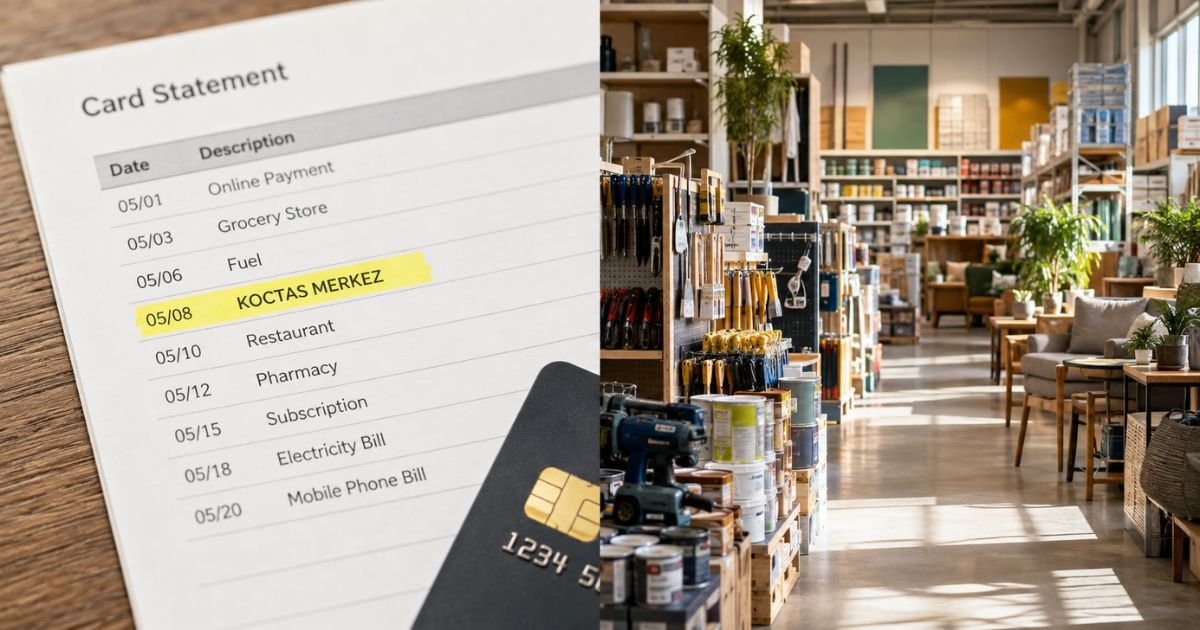
Spotting a Koctas Merkez charge on credit card can feel confusing if you don’t recall signing up for anything. Unfamiliar charges are often legitimate.
This article explains what the name usually means, how to check it against your records, and the practical steps you can take.
Table of Contents
What Is a Koctas Merkez Charge on Credit Card?
A Koctas Merkez charge on credit card is typically a purchase from Koçtaş, a major home-improvement retailer in Turkey. The company sells furniture, tools, appliances, lighting, garden goods, and building materials.
“Merkez” is Turkish for “center” or headquarters. The descriptor often points to the company’s central merchant account in the Istanbul area rather than one neighborhood store. That account is commonly used for website orders, app orders, and phone orders.
Koçtaş operates as Koçtaş Yapı Marketleri Ticaret A.Ş. It is part of the Koç Group and has a long-running partnership with Kingfisher, the parent of B&Q. Its official site is koctas.com.tr. Headquarters sit in Çekmeköy, Istanbul.
The charge is generally not a hidden subscription. It is usually a one-time retail purchase. Your issuer may show it in U.S. dollars after converting from Turkish lira. A foreign-transaction fee may appear as a separate line, depending on your card.
Who Koçtaş Is and Why the Name Looks Odd
Koçtaş began as a building-materials business and later became a large retail chain with stores, a website, and a mobile app. Shoppers in Turkey use it the way many U.S. readers use a home-improvement warehouse.
On a U.S. statement the name can look random because banks shorten merchant text. You may see KOCTAS MERKEZ, KOÇTAŞ MERKEZ, or a close variant plus a city such as Istanbul and country code TR.
Physical store receipts sometimes list a specific branch. Central or online billing more often uses the Merkez label. That is why the same company can appear under more than one descriptor.
How This Charge Usually Shows Up on Your Statement
Issuers truncate names. The exact text can vary by bank and by whether the sale ran through a store terminal or an online processor.
| What you may see | What it typically points to |
|---|---|
| KOCTAS MERKEZ or KOÇTAŞ MERKEZ | Central / HQ merchant account, often online, app, or phone |
| KOCTAS + store or city name | A specific store or Fix-format location |
| Amount in USD that feels “off” | Currency conversion from TRY plus possible issuer fee |
| Pending or “authorization” first | A hold that later posts as a final sale |
Pending authorizations typically drop or convert to a posted charge within a few days. Timing may vary by issuer.
Why You Might See a Koctas Merkez Charge
The most common reason is a real purchase. You (or someone with your card) bought something at a Koçtaş store while in Turkey, ordered on koctas.com.tr or the app, or placed a phone order.
Phone orders go through the company’s solution center. The site and app also accept credit and debit cards. There is generally no cash-on-delivery option for those channels.
Other typical causes include:
- A family member or travel companion used the card.
- You paid in lira and the dollar amount looks different after conversion.
- A return or adjustment posted as a second line.
- A small authorization check that later reversed.
If you never traveled to Turkey and never shopped the site, treat the charge as unrecognized until you confirm it.
Pro Tip: Open your bank or card app and tap the charge. Look for the original currency (often TRY), the exact date and time, and any extra merchant city. That extra detail is usually more useful than the short name on the paper statement.
How to Verify the Charge Before You Panic
Start with your own records. Check email for a Koçtaş order confirmation, shipping notice, or invoice. Check the Koçtaş app or website account if you have one. Compare the date and the converted dollar amount.
Then check the card issuer app. Many apps show the merchant country. A TR country code supports a Turkish retailer.
Call the number on the back of your card if the app data is thin. Ask for the full merchant descriptor, the original amount and currency, and the MCC (merchant category code). Home-improvement retailers typically sit in hardware or home-furnishings categories.
If you still have a paper receipt from a trip, match the date and the last four digits of the card.
Do not assume fraud on the first look. Currency conversion and truncated names cause many “mystery” lines.
What to Do If You Do Not Recognize the Charge
Act in this order.
- Confirm no one in your household used the card or saved it in a shared wallet.
- Search your email and texts for “Koçtaş,” “Koctas,” or the order number if you have one.
- Contact Koçtaş with the transaction date, amount, and last four card digits.
- If the company cannot match a sale, call your issuer and ask about a dispute or chargeback.
Koçtaş lists its customer line as 0850 209 50 50. Hours listed on company pages are generally 09:00–20:00 local time in Turkey. That is an international call from the United States.
You can also use the messages section inside a koctas.com.tr account when you have one. Official English contact pages emphasize the same phone line and do not publish a separate U.S. number.
Keep notes: date you called, who you spoke with, and any ticket number. Your bank will ask for that if you later file a dispute.
Time limits for disputes typically start from the statement date. They may vary by issuer and by card network. Do not wait weeks if the charge is large or clearly wrong.
Refunds, Returns, and Disputes
Returns at Koçtaş generally require the receipt or invoice. If you paid by card, the company typically also wants the card slip.
Company FAQ language describes a 30-day window for many returns when packaging is unopened. Rules can differ for opened goods, special orders, marketplace sellers on the site, and delivery damage.
Refunds typically go back to the same card. International refunds can take longer to show than domestic ones because two banks and a currency conversion are involved. The company may say the refund is “sent” days before it posts on your U.S. statement.
If goods never arrived, arrived damaged, or were billed twice, say that clearly when you call. Ask whether they will reverse the original authorization or issue a new credit.
If Koçtaş does not resolve it, your issuer can often open a dispute. Have the date, amount, what you expected, and copies of emails ready. Issuers generally do not promise a result. They investigate.
Common Mistakes: Waiting for the charge to “explain itself,” paying the statement in full without asking questions, or only emailing a generic inbox with no order number. Banks move faster when you give exact dates and amounts.
Complaints and Legitimacy Signals
Koçtaş is a long-established retailer, not a random pop-up merchant. That said, shoppers on Turkish complaint boards often report delivery delays, damaged furniture, installation problems, and refunds that take longer than expected.
Trustpilot shows a small sample of reviews and a low average score, with refund and shipping complaints in the comments. Sample size is limited, so treat it as a signal, not proof.
There is no meaningful U.S. Better Business Bureau file for this Turkish chain. That is normal for a company that mainly serves Turkey.
None of those complaint themes automatically make your charge fake. They do mean you should keep paperwork if you request a return.
International Fees and Why the Dollar Amount Looks Wrong
A sale in Turkish lira is converted by your card network using the rate in effect around the posting date. The dollar total on your statement may not match a memory of a price tag.
Some U.S. cards add a foreign-transaction fee, often around 3 percent. Others waive it. The fee may appear on the same day or on a later statement.
Dynamic currency conversion at a terminal can also change the amount. If a cashier offered to charge you in dollars instead of lira, the rate is typically worse. That choice is yours at the register and may vary by location.
FAQs: Koctas Merkez Charge on Credit Card
Q. Is Koctas Merkez a scam or a subscription?
A. It is typically a retail charge from Koçtaş, a known Turkish home-improvement chain. It is generally not a recurring membership fee. Confirm the date and amount against any trip, website order, or family use before you treat it as fraud.
Q. Why does the name say Merkez instead of a store I remember?
A. Merkez usually refers to the company’s central billing account. Online, app, and phone orders often post that way. Individual stores may use a longer branch name. Your issuer shortens whatever text the merchant sent.
Q. How do I contact Koçtaş from the United States?
A. Company pages list 0850 209 50 50 as the customer and telephone-order line. Expect an international call and Turkish business hours. Have the charge date, amount, and last four card digits ready. Policies and wait times may vary.
Q. What if I already paid the statement?
A. Paying the bill does not usually cancel your right to question the item. You can still contact the merchant and your issuer. Ask your bank how a later credit or dispute would appear. Timing and rules may vary by issuer.
Conclusion
A Koctas Merkez charge on credit card is most often a real Koçtaş purchase billed through the company’s central account. Match the date, original currency, and any order email first.
If nothing lines up, call the merchant with specifics, then your card issuer. Keep the conversation factual and written down so you can follow up.
Disclaimer: This article is for general information only. It is not financial, legal, or tax advice. Card network rules, merchant refund policies, and issuer dispute windows vary. Confirm details with Koçtaş and with the bank that issued your card before you act.
Meet the Author
