
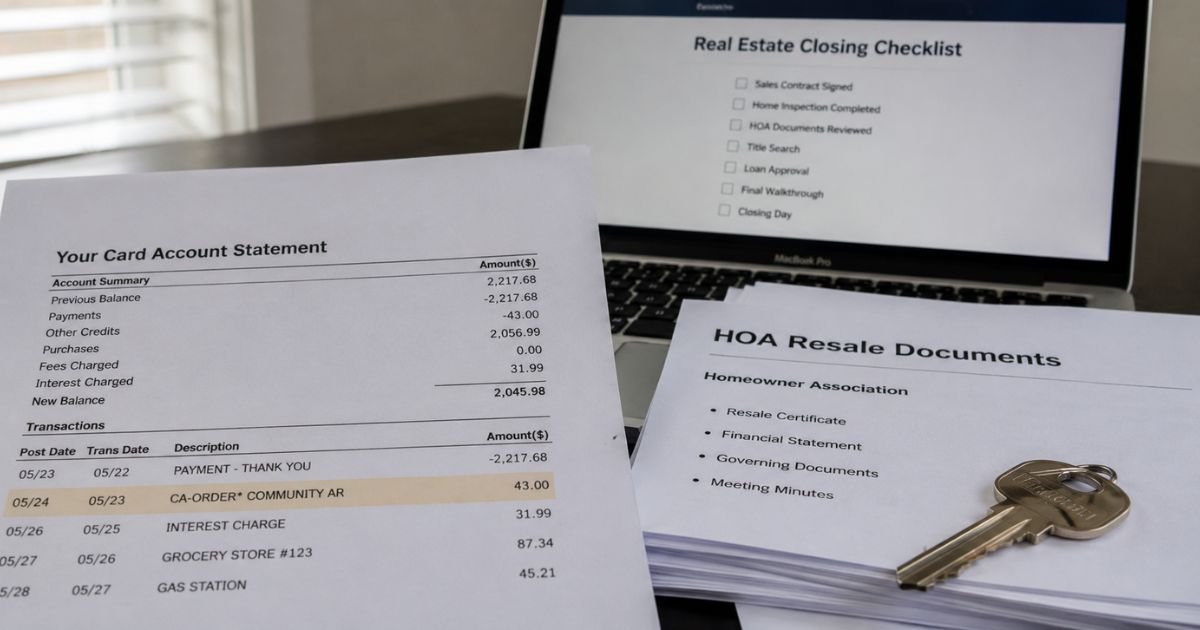
Spotting a CA Order Community AR charge on credit card can feel confusing if you don’t recall signing up for anything. Unfamiliar charges like this are often legitimate and tied to a real estate or HOA process.
This guide explains what the charge typically means, why it shows up, and the practical steps you can take to verify or resolve it.
Table of Contents
What Is the CA Order Community AR Charge on a Credit Card?
The CA Order Community AR charge (also seen as CA-ORDER* COMMUNITY AR, CA-ORDER* COMMUNITY RICHARDSON TX, or similar variations) generally comes from Community Archives.
This company processes and delivers resale disclosure documents, estoppel certificates, governing documents, and related packets for homeowners associations (HOAs) and property owners associations.
These documents are commonly required during a home sale, purchase, refinance, or ownership transfer in an HOA community.
Buyers, sellers, realtors, lenders, or title companies often order them. Community Archives acts as a fulfillment service for many HOAs and management companies.
The “CA” likely stands for Community Archives, “ORDER” indicates a document order, and “AR” or the Richardson TX reference points to the company’s location.
Community Archives was founded in 2006 and was acquired by TownSq in 2022. It operates on a per-transaction basis rather than as a recurring subscription. Charges usually appear as one-time fees for specific document packages.
The company is based in Richardson, Texas (addresses commonly listed as 1225 Alma Rd or a PO Box in Richardson). Official site is communityarchives.com.
Why This Charge Appears on Your Statement
You or someone connected to a real estate transaction involving your property (or a property you are buying or selling) typically placed an order for HOA-related documents. Common triggers include:
- A buyer or their agent requesting a resale package or disclosure packet.
- A lender needing an estoppel letter or questionnaire for a mortgage or refinance.
- A title company or closing agent ordering required association documents.
- A seller fulfilling state or HOA requirements before closing.
In many states, sellers in HOA communities must provide these documents. Fees for preparing and delivering the package are often paid by the buyer, seller, or agent and billed through Community Archives.
Amounts can vary widely depending on the documents ordered, rush options, and the specific HOA’s pricing. Some consumers report fees in the low hundreds of dollars.
The charge is not usually a subscription. It is a one-time professional services fee for document fulfillment.
How the Charge May Appear on Statements
Merchant descriptors can vary by card issuer and processing. Common variations include:
| Descriptor Variation | Notes |
|---|---|
| CA-ORDER* COMMUNITY AR | Common short form |
| CA-ORDER* COMMUNITY RICHARDSON TX | Includes location |
| CA ORDER*Community AR Richardson | Slight spacing differences |
| CHKCARD CA-ORDER* COMMUNITY… | Bank-specific prefix |
| POS PUR CA-ORDER* COMMUNITY… | Point-of-sale style |
Always match the amount and date to any email receipt or order confirmation you may have received.
Is Community Archives Legitimate?
Community Archives is a real company that has operated for years in the HOA document space. It partners with management companies and associations across multiple states. Its parent company, TownSq, is an established community management technology platform.
BBB lists Community Archives with a B rating. It is not BBB Accredited. A small number of complaints (around six in available records) mention slow fulfillment, order delays, and billing or payment processing issues.
Trustpilot shows limited reviews with mixed feedback, including concerns about pricing and customer service.
These signals do not mean every charge is fraudulent. Many people successfully receive the ordered documents. Still, high fees and service complaints appear in consumer reports, so verification is wise if you do not recognize the order.
What to Do If You See the CA Order Community AR Charge
- Check your email (including spam) for a receipt or order confirmation from Community Archives or the related HOA/management company. Look for order numbers, document lists, and amounts.
- Think about recent real estate activity. Did you buy, sell, refinance, or transfer property in an HOA community? Did a realtor, lender, or title company handle paperwork on your behalf?
- Contact Community Archives support directly. Commonly listed numbers include (833) 544-7031 and (833) 462-3627. Email options such as customerservice@communityarchives.com or shoppersupport@communityarchives.com appear in multiple sources. Have your statement date, amount, and any order reference ready.
- Reach out to the HOA or property management company tied to the property. They often initiate or authorize these orders.
- If the charge is truly unauthorized and no one in your household or transaction authorized it, dispute it with your card issuer promptly. Federal rules generally give you 60 days from the statement date to report billing errors.
Pro Tip: Keep all real estate closing emails and receipts for at least a year. HOA document charges can post days or weeks after the actual order.
How to Request a Refund or Dispute the Charge
Contact Community Archives first and provide the order number if you have it. Ask whether the documents were delivered and whether a refund is possible for unused or duplicate orders. Policies vary and are not guaranteed.
If the merchant does not resolve it, file a dispute with your credit card issuer.
Explain that you did not authorize the transaction or that services were not provided as expected. Your issuer will typically investigate under Fair Credit Billing Act guidelines. Keep records of all communications.
Do not ignore the charge. Unresolved legitimate charges can lead to collection activity from the merchant or HOA.
Common Mistakes: Assuming every unfamiliar charge is fraud without checking recent property activity, or waiting too long to contact the merchant or your bank.
FAQs: CA Order Community AR Charge on Credit Card
Q. Is the CA Order Community AR charge a scam?
A. No. Community Archives is a legitimate company that fulfills HOA resale and disclosure document orders. Some consumers report high fees or slow service, but the business itself is real and has operated for nearly two decades.
Q. Why was I charged if I never ordered anything myself?
A. A realtor, buyer, seller, lender, or title company involved in a property transaction linked to an HOA you are connected with typically places the order. The charge then appears on the card used for payment.
Q. How much does a Community Archives order usually cost?
A. Amounts vary by the documents requested, any rush fees, and the specific association’s pricing. Consumers have reported figures ranging from under $100 to several hundred dollars. Check your specific receipt or contact support for the exact breakdown.
Q. Can I cancel or get a refund for this charge?
A. Contact Community Archives with your order details as soon as possible. Refunds are not automatic and depend on whether documents were already delivered and the merchant’s policy. If unsuccessful, dispute the charge with your card issuer within the allowed timeframe.
Conclusion
The CA Order Community AR charge on credit card is typically a one-time fee from Community Archives for HOA resale documents, estoppel letters, or similar packets needed in a real estate transaction.
It is generally legitimate when connected to a property sale, purchase, or refinance involving an association.
Verify the order against your recent activity, check for receipts, and contact Community Archives or the related HOA if anything looks wrong.
Most people resolve recognition questions quickly once they connect the charge to a closing or refinance. Always confirm details with your own records and the company, since individual cases can differ.
Disclaimer: This article is for informational purposes only and is not financial, legal, or professional advice. Policies, fees, and dispute outcomes vary by issuer, merchant, and individual circumstances. Verify any account-specific questions directly with Community Archives, your HOA, or your bank or credit card company.
Meet the Author
