
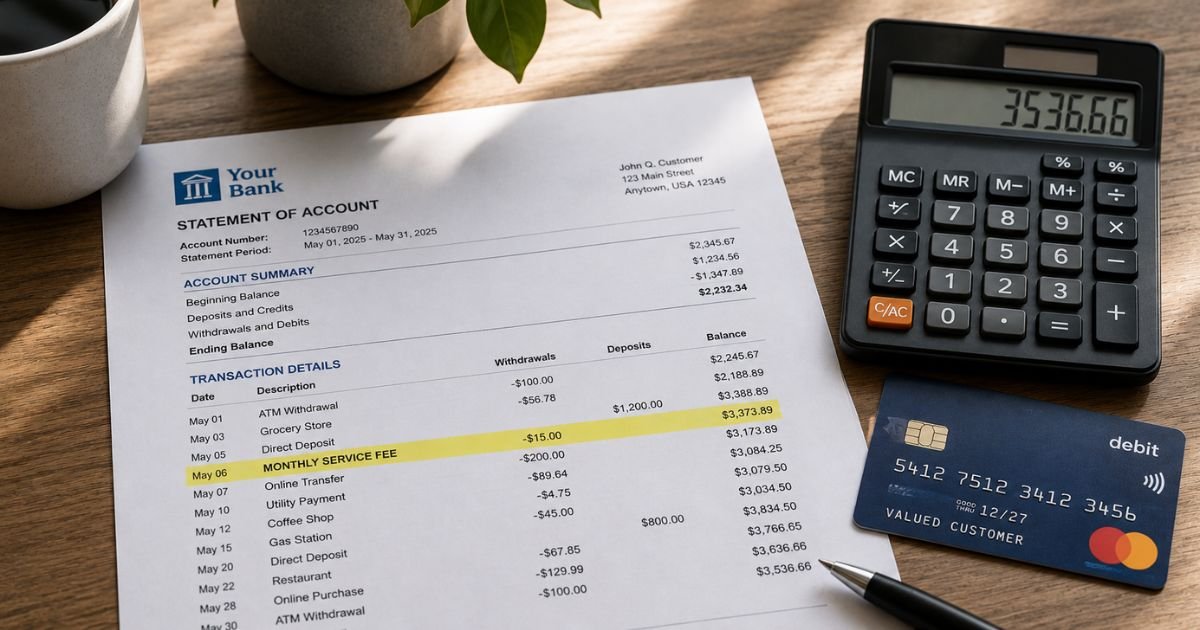
You open your bank statement or check your online activity and see a line that simply says “Service Charge,” “Monthly Service Charge,” or “Account Service Fee.” The amount is often $5 to $25, and it can feel like money disappearing for no clear reason.
In most cases this is a legitimate fee from your own bank for maintaining your checking or savings account. Still, you should understand exactly what triggered it and whether you can avoid it going forward.
This guide explains what a service charge means on a bank statement, the common reasons it appears, how to verify it, and practical steps to reduce or eliminate these fees.
Table of Contents
What Is a Service Charge on a Bank Statement?
A service charge is a fee your bank or credit union charges for providing and maintaining your deposit account. Banks use these fees to cover the costs of keeping your account open, processing transactions, providing customer support, and offering related services.
On statements it most often appears as:
- Service Charge
- Monthly Service Charge
- Monthly Maintenance Fee
- Account Service Fee
- Service Fee
It is almost always charged by your own bank, not by an outside merchant. The fee is usually posted near the end of the statement cycle.
Banks and credit unions are allowed to charge these fees under federal rules. They must disclose the amounts and any ways to avoid them when you open the account.
Why Did This Charge Appear?
Here are the most common reasons a service charge shows up:
- Your account did not meet the bank’s requirements to waive the monthly maintenance fee (for example, falling below a minimum balance).
- You did not have a qualifying direct deposit during the statement period.
- The account is a basic checking or savings product that carries a standard monthly fee.
- You requested paper statements instead of electronic ones (some banks charge a paper-statement service fee).
- The fee covers general account maintenance and is applied automatically each cycle.
Typical monthly service charges range from about $5 to $25, depending on the bank and account type.
Many institutions waive the fee if you meet simple conditions such as keeping a minimum daily balance, receiving a direct deposit, or making a set number of debit-card purchases.
How to Verify the Charge
Follow this checklist:
- Look at the exact date, amount, and full description on your statement or online activity.
- Review your account agreement or fee schedule (usually available in online banking or on the bank’s website).
- Check whether you met any waiver requirements during that statement cycle (minimum balance, direct deposit, etc.).
- Log into online banking and look for any messages or notices about fees.
- Call the number on the back of your debit card and ask the bank to explain the specific service charge.
- Compare the fee amount to the disclosed rate in your account documents.
If the amount matches the bank’s published fee and the timing aligns with the statement cycle, it is almost certainly a standard account fee.
Is It Legitimate or Fraud?
Common legitimate scenarios
- Monthly maintenance fee for not meeting waiver conditions
- Paper statement fee
- Standard account service charge disclosed when you opened the account
Warning signs
- The amount is much higher than any fee listed in your account agreement
- Multiple service charges appear in the same cycle without explanation
- The description looks unusual or includes a company name you do not recognize
A plain “Service Charge” from your own bank is almost always legitimate. If the description looks different or the amount seems wrong, contact the bank right away for clarification.
How to Cancel or Stop Future Service Charges
You cannot cancel a single posted service charge the way you cancel a subscription, but you can often stop future ones.
- Review your account’s fee-waiver requirements in the account agreement or online banking.
- Meet one of the common conditions: maintain the required minimum balance, set up direct deposit, or make the required number of transactions.
- Switch to electronic statements if a paper-statement fee is being charged.
- Ask the bank whether a different account type has lower or no monthly fees.
- If the fee was applied in error, request a one-time waiver or refund.
Many banks will reverse a fee as a courtesy the first time you ask, especially if you are a long-time customer.
Can You Get a Refund?
Yes, in some cases:
- If the fee was charged by mistake or the bank failed to apply a waiver you qualified for, request a refund.
- Some banks offer one-time fee waivers as a customer-service gesture.
- Keep records of the conversation and any reference numbers.
Refunds are not automatic. You usually need to contact the bank and specifically ask. There is no standard dispute timeline like a credit-card chargeback, because this is a fee from your own bank.
What to Do If the Charge Seems Wrong
- Call your bank using the official number on your card or statement.
- Ask for a clear explanation of the service charge and whether any waiver should have applied.
- Request a refund or one-time courtesy waiver if appropriate.
- Review your account agreement to confirm the fee was disclosed.
- If you are not satisfied, ask to speak with a supervisor or the bank’s escalation team.
- As a last step, you can file a complaint with the Consumer Financial Protection Bureau at consumerfinance.gov.
Prevention Tips
- Read your account’s fee schedule and note the exact waiver requirements.
- Set up direct deposit of your paycheck or benefits if that waives the fee.
- Keep the required minimum balance if that is the easiest option for you.
- Switch to free electronic statements.
- Review your statement every month so fees do not go unnoticed.
- Ask the bank about free or low-fee account options that better match your habits.
- Consider moving to a credit union or online bank that offers truly free checking if fees become a regular problem.
- Turn on account alerts for low balances so you can avoid dipping below minimums.
Common Types of Service Charges
| Description on Statement | Typical Meaning | Usual Range |
|---|---|---|
| Service Charge / Monthly Service Charge | Account maintenance fee | $5–$25 |
| Paper Statement Fee | Charge for mailed paper statements | $2–$5 |
| Account Maintenance Fee | Same as monthly service charge | $5–$25 |
| Service Fee | General bank fee for account services | Varies |
Ways to Avoid Monthly Service Charges
| Common Waiver Condition | What You Usually Need to Do |
|---|---|
| Minimum daily balance | Keep the required amount in the account |
| Direct deposit | Have a qualifying electronic deposit each cycle |
| Combined balances | Maintain a total across linked accounts |
| Debit-card activity | Make a set number of purchases |
| Age-based or student status | Qualify under special account rules |
FAQs: Service Charge Mean on Bank Statement
Q. Is a service charge the same as an overdraft fee?
A. No. An overdraft fee is charged when you spend more than your available balance. A service charge is usually a monthly fee for simply having the account.
Q. Can my bank raise the service charge without telling me?
A. Banks must disclose fee changes in advance according to federal rules. Check your statements and online notices for any updates.
Q. Why did I get a service charge when I thought my account was free?
A. Many “free” accounts still carry a monthly fee that is waived only if you meet certain conditions. Falling short of those conditions triggers the charge.
Q. How do I find the exact fee schedule for my account?
A. Log into online banking, look under Account Documents or Fee Schedule, or call the bank and request a copy of your account agreement.
Conclusion
A service charge on bank statement is almost always a monthly maintenance or account fee charged by your own bank for keeping the account open. It is a standard, disclosed cost that many people can avoid by meeting simple requirements such as a minimum balance or direct deposit.
Verify the charge against your account agreement, ask the bank for a clear explanation if needed, and take steps to qualify for a waiver going forward. Understanding this fee helps you keep more of your money and choose the right account for your habits.
Disclaimer: This article is for informational purposes only and is not financial or legal advice. Bank fees and policies vary. Always confirm details directly with your bank or credit union and review your specific account agreement.
Meet the Author
